
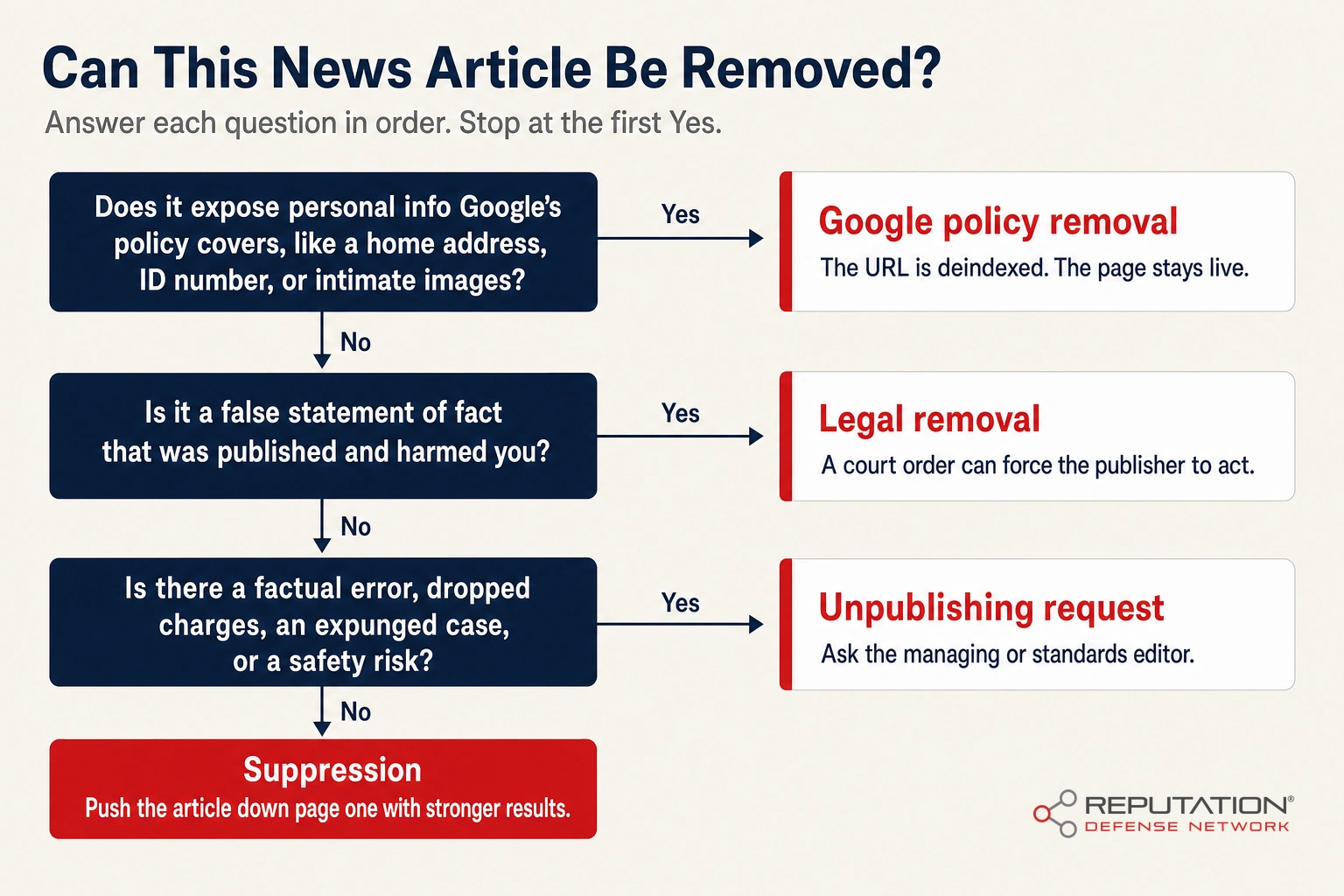
Google will remove a news article from search results only when it exposes specific personal information such as a home address or ID number, shows nonconsensual intimate imagery, or has been ruled unlawful by a court. Google deindexes the URL but cannot delete the page. Only the publisher can remove the article itself, and accurate reporting usually stays online.
Knowing which route fits your situation saves months of wasted effort. Most people start by asking Google to delete a story, then learn that Google controls far less than they assumed.
News article removal happens through four routes including a publisher agreement, legal order, platform policy removal through Google, or suppression when the first three are off the table. Each route has a different decision maker and timeline as well as cost.
Once you understand how each one works, it becomes much easier to see which applies to your article and which stories tend to stay online no matter who asks.
Key Takeaways
- Three things take an article down. A publisher agrees to change or remove it, a court orders it, or a platform policy covers it. Everything else is suppression.
- Google removes URLs from search but not pages from the internet. A successful Google request hides the link in results, but the article stays live on the publisher’s site.
- Accurate, newsworthy reporting usually stays up. When a story is true and covers a matter of public concern, suppression is the realistic path.
- Timelines depend on the removal route. Policy removals typically resolve in weeks while legal routes can take months.
- Cost tracks the removal route, not the article. A single outdated page and a syndicated national story are priced very differently.
Can a News Article Be Removed from Google?
The short answer to the very pressing question of whether articles can be removed from google is, yes, in some cases. Google will remove a news article from search results when it exposes particular personal information or contains nonconsensual intimate imagery. It may be removed if it has been ruled unlawful by a court.
Publishers can delete their own stories, but accurate reporting on a matter of public concern usually stays online. For accurate reporting, suppression becomes the practical answer. Most confusion about news article removal comes from treating three different outcomes as one.
When people ask if you can get a news article removed from the internet, they usually mean one of the following:
Removal at the source. The publisher edits or deletes the article on its own website. This is the only outcome that makes the story disappear everywhere, and only the publisher (or a court directing the publisher) can make it happen. Once the page is gone, search engines drop it over time.
Deindexing from Google. Google removes the URL from its search results, but the article stays on the publisher’s site. Anyone with the direct link can still read it, and other search engines such as Bing may still show it.
Suppression. The article stays online and stays indexed, but stronger, more relevant results push it down the page where few people look. Suppression does not remove articles but instead changes what a searcher sees first.
How Do You Get a News Article Removed?
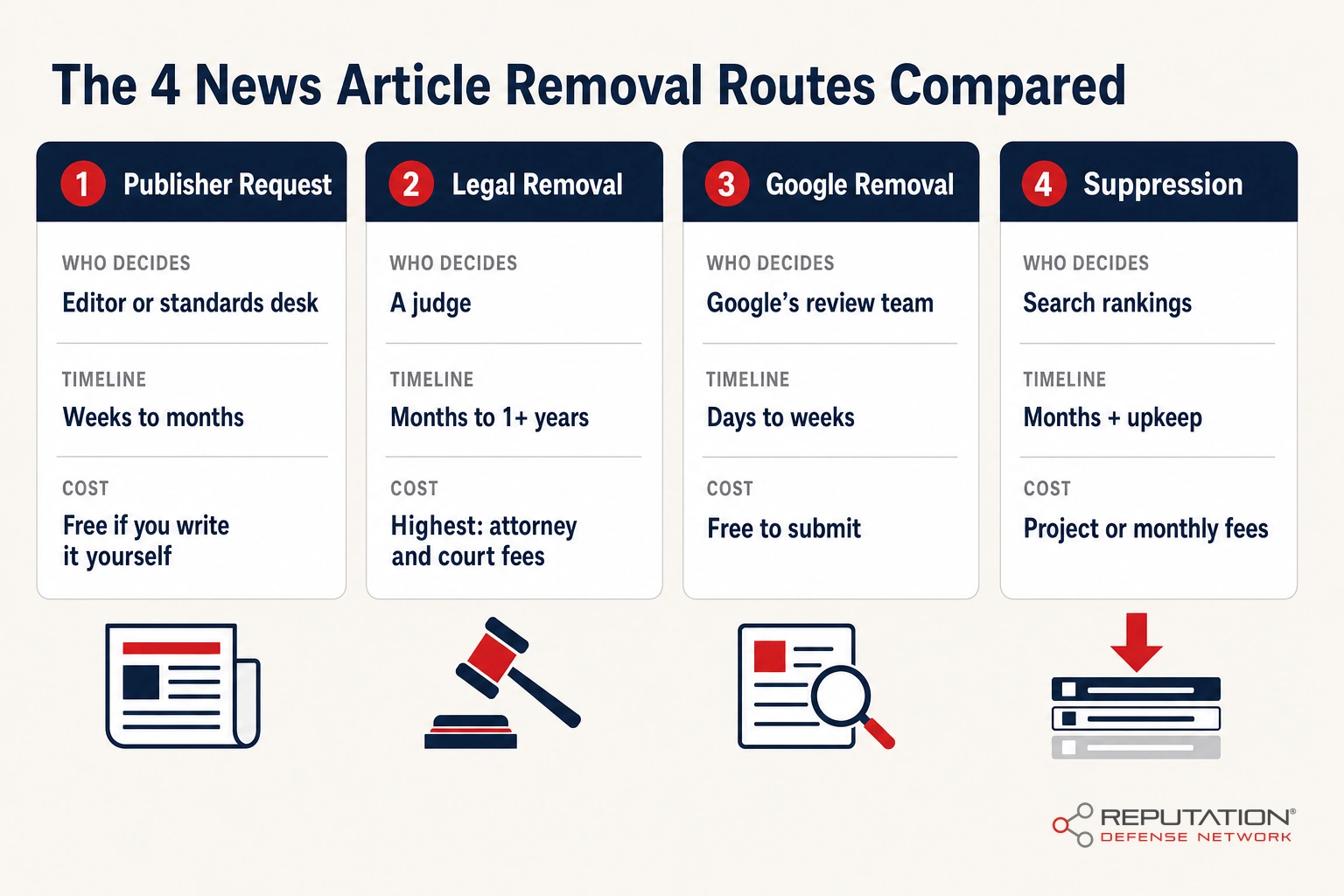
Here is how the four routes compare:
| Route | Who Decides | Typical Timeline | What it Costs |
|---|---|---|---|
| 1. Publisher agreement or unpublishing request | Editor or Standards Desk | Weeks to Months | Free if you write the request yourself. Professional fees apply if someone handles outreach. |
| 2. Legal removal through a court order or defamation claim | Judge or Publisher under legal pressure | Months to 1+ Years | The highest of the four, driven by attorney fees and court costs |
| 3. Platform and policy removal through Google | Google’s review team | Days to Weeks | Free to submit. Fees apply if you hire help. |
| 4. Suppression | Rankings respond to new content | Months + Upkeep | Project or monthly fees that scale with competition |
Not sure which route fits your article? A free case review tells you in one call. Request a confidential review.
1. Publisher Agreement or Unpublishing Request
An unpublishing request asks a newsroom to delete, anonymize, or significantly change a story it already published. For anyone researching how to get a news article removed at the source, this is the first route to try, because only the publisher controls the original page.
Editors will seldom delete accurate reporting, so the request needs a reason other than embarrassment. The situations most likely to compel an editor are:
- A factual error the outlet can verify.
- Criminal charges that were dropped or ended in acquittal.
- A case that has since been expunged or sealed.
- A documented safety risk, such as stalking or threats tied to the story.
The editor must sign off on the removal as the original reporter usually lacks authority to change archives. Address the request to the managing editor or standards editor.
Newsrooms resist these requests for principled reasons. The Society of Professional Journalists Code of Ethics asks journalists to minimize harm and consider the lasting reach of what they publish, and it also asks them to update and correct as opposed to erase.
Press freedom groups like the Reporters Committee for Freedom of the Press defend public access to the record. Policies can also vary widely. Research by Deborah Dwyer through the Reynolds Journalism Institute found that most surveyed newsrooms had some unpublishing policy, but many had never put it in writing (Unpublishing the News).
There are some outlets that have formalized a path for older minor crime coverage such as The Boston Globe’s Fresh Start program which reviews requests to update or anonymize those stories. Never offer money to a newsroom as it damages the request and can later turn into its own story.
First step: Identify the managing or standards editor and send a short, factual request with your documentation attached.
2. Legal Removal Through a Court Order or Defamation Claim
A legal route uses a court judgment or order to force removal, typically after a finding that the content is defamatory or otherwise unlawful.
A defamation claim generally needs three things:
- A false statement of fact. The statement must be provably untrue and not a matter of interpretation.
- Publication. The statement reached people other than you.
- Harm. The statement damaged your reputation, business, or livelihood.
Most states also require some degree of fault, and public figures face a higher bar. Opinion is not defamation, and neither is accurate reporting, no matter whether it is painful. Truth is a complete defense, and fair and accurate reports of official records such as arrest reports are commonly protected.
A judge must sign off on legal removal. A court order can do what a polite request cannot by directing a publisher to act. Google reviews court orders when deciding to remove a URL. Deadlines matter as the statute of limitations for defamation varies by state and often runs from the date of first publication, so waiting can close this route entirely.
Our legal network handles these cases with attorneys licensed in the relevant state.
First step: Save dated copies of the article and speak with a defamation attorney before your filing window closes.
3. Platform and Policy Removal Through Google
A request can be made asking Google to remove a news article from Google search results under one of its published policies. Be precise regarding the outcome and note that Google deindexes the URL but does not delete the page.
Google’s personal information removal policy covers specific categories, including:
- Home address, phone number, and email address.
- Government ID numbers, such as a Social Security number.
- Bank account and credit card numbers.
- Images of a handwritten signature or an ID document.
- Medical records and similar restricted records.
- Login credentials.
- Doxxing, meaning personal details shared with intent to harm.
Google also removes nonconsensual intimate imagery and content covered by its legal removal policies. The free Results About You tool monitors search for your contact details and lets you request removal from one dashboard.
Note that Google weighs public interest, and for news pages it may remove a result only for searches of your name instead of for every query.
The Outdated Content tool is commonly misunderstood as it only works after the page has already changed or been deleted, and it tells Google to refresh a stale snippet or drop a dead link. It cannot remove a live article.
Google’s review team must sign off, based on its policies. For requests outside these categories, a tactical removal review can identify if another policy applies.
First step: Check whether the article contains any of the listed personal details, then submit the URL through Google’s removal form.
4. Suppression When Removal Is Off the Table
Suppression pushes a negative article lower in search results without removing it. Most searchers click one of the first few results, and attention drops sharply below the third position.
Suppression applies when the story is accurate, the publisher declines removal, and no policy or legal claim fits. Many people who set out to remove negative news articles end up here.
No one signs off on suppression, because rankings respond to the content that competes for your name. Suppression requires owned assets (a personal site, professional profiles, published work) combined with time and consistency. The honest tradeoff is that the article still exists, and anyone who looks hard enough can find it.
Learn how search control works or compare the two approaches in removal vs. suppression.
First step: Search your name in a private browser window and list every result on page one that you own or could influence.
Can You Remove Your Name Without Removing the Article?
Sometimes. When a publisher will not delete a story, it may still agree to a partial remedy:
- A correction that fixes a specific factual error.
- An update that adds the outcome, such as a dismissal or acquittal.
- Anonymization, which replaces your name with a description or initials.
- Removal of a photo or other identifying detail.
These outcomes depend on the publisher’s editorial policy and your circumstances, and none is guaranteed. Requests are prone to be stronger when the information is inaccurate, badly outdated, tied to charges that were resolved in your favor, or linked to a documented safety concern.
What Happens If a News Article Was Republished or Syndicated?
Removing or changing the original article does not guarantee that every copy disappears. Wire stories, syndication partners, aggregators, and archive sites can each hold their own version. Start by identifying every live URL and sorting each one by who controls it:
- The original publisher, including its sister sites and print archive pages.
- A syndication partner that licensed the story and may follow the original’s lead.
- An independent site that copied or summarized it and answers to no one upstream.
Each category needs its own request, and independent copies may need a separate policy or legal basis. Widespread republication makes a case more complex, and not every copy can be removed. When coverage spreads fast, a crisis management plan can help contain it early.
What News Articles Will Google Not Remove?
Why can’t I delete something from my Google search?
Google indexes pages it does not own, and its removal policies are narrow by design. If the content does not fit a listed category, Google leaves it in place. These four categories almost always stay:
- Accurate reporting on a matter of public concern. A local paper’s story on a business owner’s code violations, reported correctly, will not be removed because it hurts the business.
- Court records that are still public. A civil lawsuit or criminal case that has not been sealed or expunged stays part of the public record, and news coverage of it generally stays.
- Opinion and criticism. An editorial calling a public official’s decision reckless is protected commentary, even if the official strongly disagrees.
- Content you agreed to at the time. An interview you gave a reporter years ago, now regretted, is not a policy violation. Newsrooms call this source remorse, and it rarely leads to deletion.
You are not left without options, but if your situation meets one of these parameters, your path runs through suppression, updates, or anonymization as opposed to removal.
Why Do Negative News Articles Rank So High on Google?
Negative news articles rank well for three reasons: publisher authority, freshness and engagement, and little competition for your name.
Publisher authority. News sites have years of links from other sites, and Google treats that history as a strong trust signal. A story on an established outlet starts with an advantage almost no personal page can match.
Freshness and engagement. New stories get a ranking lift, and negative headlines can draw clicks and shares. Each click tells Google the result is relevant to the search.
Little competition for your name. Most people have few pages built around their name. When someone searches it, the article may be one of only a handful of relevant results.
For these reasons, most DIY attempts stall. A new social profile or blog post is not likely to outrank a strong news domain without steady, deliberate effort.
How Long Does News Article Removal Take?
News article removal takes days to weeks through a Google policy request, a few weeks to a few months through a publisher, and several months to over a year through the courts. The ranges below are typical but cannot be promised.
| Route | Typical Range |
|---|---|
| Google policy removal | Days to Several Weeks |
| Outdated Content refresh (after the page changes) | Days to a Few Weeks |
| Publisher request | A Few Weeks to a Few Months |
| Legal route | Several Months to 1+ Years |
| Suppression | Several Months + Ongoing Upkeep |
What speeds up a case: a documented factual error, expungement order, or cooperative regional publisher.
What slows it down: a national outlet, active lawsuit, or syndicated copies on twenty sites.
How Much Does News Article Removal Cost?
The cost of news article removal depends on which removal route applies. Google policy requests are free to submit, and a publisher request you write yourself costs only your time. Legal routes cost the most because of attorney and court fees, and suppression is priced as a project or monthly engagement.
A syndicated story costs more than a single source story because every live copy is its own case with its own request. You will usually meet three pricing models including a flat fee per URL, a monthly retainer, or pay on success, where you pay only after removal.
Before agreeing to any of them, confirm in writing what counts as success. Be wary of anyone who quotes a price before seeing the URL, since no honest provider can price a case without knowing the publisher and the facts.
Should You Remove a News Article Yourself or Hire Help?
If you are learning how to remove news articles from the internet on your own, start with the cases that are clearly within reach.
| Handle Yourself | Hire Help |
|---|---|
| One outdated page that has already changed or been deleted | Coverage syndicated across many sites |
| A data broker or people search listing | An uncooperative national outlet |
| A clear violation of a Google policy, such as an exposed address or ID number | Anything that needs a court order or defamation claim |
| A polite first request to a local editor with strong documentation | A case with an approaching legal deadline |
The DIY path works well when you keep it organized. Save dated screenshots of every URL, keep copies of court documents, write to the right editor by name, and track every request and reply in one place.
Free download: News Article Removal Request ChecklistA one-page checklist for preparing and sending a removal request.
How Does Reputation Defense Network Remove News Articles?
Reputation Defense Network has resolved over 7,500 cases, and every news article removal case follows the same four steps:
- Case review. We examine every copy of the article and your documentation, then tell you plainly what is possible.
- Route selection. We match the case to the route most likely to work.
- Execution. We prepare and submit the requests, follow up with editors and platforms, and coordinate with attorneys when a legal route applies.
- Verification. We confirm the result across search engines and monitor for copies that reappear.
Our attorney network is the reason legal routes are available without sending you to a separate firm. Across our cases, we maintain a 96% success rate. See why clients choose RDN.
Every case is handled confidentially. We never contact a publisher or file a request without your approval, and your name is never used in our marketing.
Frequently Asked Questions
Can I ask a newspaper to remove an article about me?
Yes, you can ask. Editors grant full removal rarely, and the strongest grounds are a verifiable factual error or charges that were dropped, dismissed, or expunged. A correction, update, or anonymized name is a more likely outcome than deletion.
How do I get a news article removed from Google?
Google removes a URL from search only when it falls under a specific policy, such as exposed personal information or a court order. Use the Results About You tool for personal details and the Outdated Content tool once the page has changed. When no Google policy applies, the publisher is usually the better path.
Can a news article be removed if the charges were dropped?
Often, yes. Dropped charges and expungements are among the strongest arguments you can bring to an editor, and many outlets now have update or unpublish policies for exactly such a situation. A copy of the dismissal or expungement order makes the request far more persuasive.
Does removing an article from Google delete it from the website?
No. Google can remove a URL from its search results, but only the publisher can delete the page itself. That difference matters, because anyone with the direct link can still open the article, and it may still appear on Bing or other search engines.
How much does it cost to remove a news article?
It depends on the route, not the article. Google requests are free, publisher outreach costs less than legal action, and syndicated stories cost more than single copies. Pay on success pricing exists, but confirm in writing what counts as success before you agree.
Is news article removal permanent?
It depends on how it was removed. Deletion at the source is permanent. Deindexing from Google can reverse if the publisher changes or republishes the page. Suppression needs ongoing maintenance, because new content about you can shift rankings over time.
Get a Free Case Review
A free case review gives you a straight answer on which route applies to your article and what outcome is realistic. The review is confidential, and nothing is sent to a publisher or platform without your approval. Start your free consultation or contact our team directly.

RDN is dedicated to helping businesses of all size make informed decisions. We adhere to strict editorial guidelines our content meets and maintains our high standards.
Prefer RDN in your Google results? Add us as a preferred source on Google.
Related Articles

How Much Does News Article Removal Cost? 2026 Pricing
Published on October 8, 2026
By Scott Bates · Reviewed by Lamont S. News article...

Content Removal Services: How They Work and What They Cost
Published on October 7, 2026
By Scott Bates · Reviewed by Lamont S. Content removal...
News Article Removal: What Google Will Actually Delete
Published on October 7, 2026
By Scott Bates · Reviewed by Lamont S. Google will...