
Content removal services work by matching each harmful URL to one of six routes: publisher outreach, platform policy takedowns, Google deindexing, legal action, data broker removal, or suppression. Most firms charge a flat fee per URL, a monthly retainer, or a pay on success fee. Some content, such as accurate reporting, cannot be removed at all.
What is possible in your situation comes down to which of the six routes your content needs. Each route works differently, costs a different amount, and solves a different kind of problem. Knowing which applies to you is also the quickest way to tell a capable firm from a reseller.
Key Takeaways
- Content removal means six different things, and providers seldom tell you which one they are selling you.
- Source removal is permanent. Deindexing hides a page from search results while the page stays online, and it can be reversed.
- Pricing runs on one of three models including a flat fee per URL, a monthly retainer, or payment only when the content comes down.
- No firm can guarantee removal of accurate reporting on a matter of public interest.
- The clearest red flags are a fixed quote before anyone reviews your URL, a removal guarantee, and no named legal capability.
What Do Content Removal Services Do
Content removal services find harmful material regarding a person or business online, decide which removal route applies to each URL, and then pursue it. That entails contacting publishers, filing platform reports, submitting search engine requests, or coordinating legal action.
When removal is not possible, a good service says so and recommends suppression as an alternative. It’s important to note that a removal firm is not the same as a data broker subscription.
Subscription tools send automated removal requests to people search sites on a schedule. They handle one narrow problem well by focusing on your address and phone number appearing on dozens of listing sites. They do not negotiate with a newspaper editor or report an impersonation account, nor can they prepare a defamation claim.
A removal firm is also not an SEO agency which builds rankings for pages you own. An SEO agency can help with suppression, but it has no process for getting a page on someone else's site deleted.
If a provider's entire plan involves publishing new content, you are buying suppression, whatever the sales page calls it.
What separates a real removal firm is the case file. A properly built file contains:
- Every URL where the content appears, including syndicated copies and scraper sites.
- Dated screenshots of each page, captured before any request goes out.
- The publisher, site owner, and hosting provider for each URL.
- The specific policy, law, or factual error each item may involve.
- A log of every request sent, every reply received, and every follow up date.
A case manager usually owns the file, and a researcher maps the copies, while an attorney reviews anything that touches defamation or a court order. If a firm cannot describe who handles your file, assume no one does.
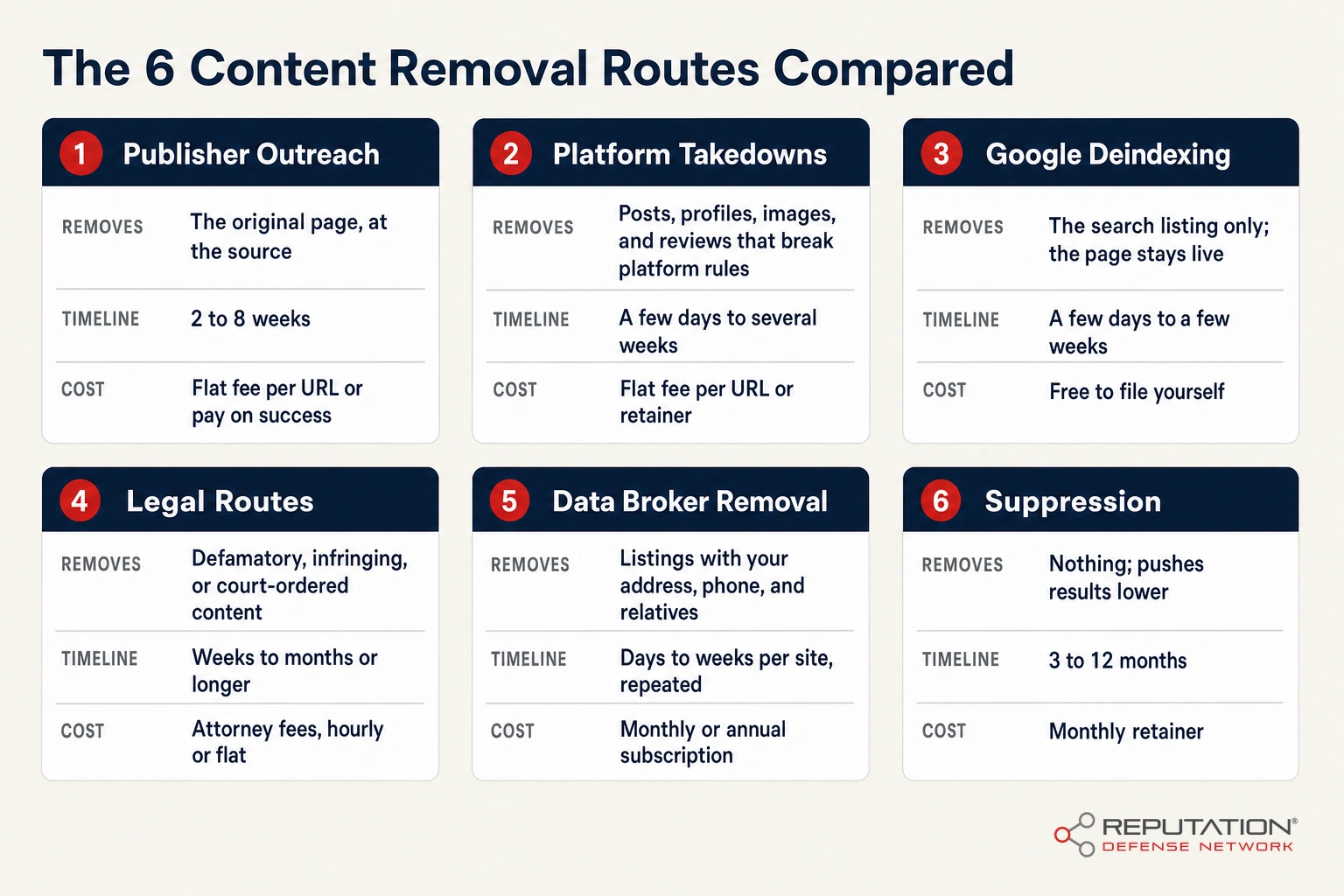
How Do Content Removal Services Remove Content?
| Route | What It Removes | Who Decides | Typical Timeline | Typical Cost Model |
|---|---|---|---|---|
| Publisher and webmaster outreach | The original page, at the source | The site owner or editor | 2 to 8 weeks | Flat fee per URL or pay on success |
| Platform policy takedowns | Posts, profiles, images, and reviews that break platform rules | The platform's trust and safety team | A few days to several weeks | Flat fee per URL or included in a retainer |
| Google deindexing | The search listing only; the page stays live | A few days to a few weeks | Free to file yourself; low cost through a firm | |
| Legal routes | Defamatory, infringing, or court ordered content | A court, or a host acting on legal notice | Weeks for DMCA; months or longer for litigation | Attorney fees, hourly or flat |
| Data broker and people search removal | Listings showing your address, phone, and relatives | Each broker, under its own process | Days to weeks per site, repeated indefinitely | Annual or monthly subscription |
| Suppression | No removal but pushes results lower | Search engine ranking systems | 3 to 12 months | Monthly retainer |
Not sure which route describes your problem? Our team can review your URLs and tell you which route applies.
1. Publisher and Webmaster Outreach
Publisher and webmaster outreach is the most common removal route and the least understood. It requires asking the person who controls a page to take it down, edit it, or add a tag that keeps it out of search results.
Who gets contacted: The author, editor, site owner, and sometimes the hosting provider when the owner will not respond.
What a persuasive request contains:
- The exact URL and the specific passage at issue.
- A factual reason, such as dismissed charges, an error, or a safety risk.
- Supporting documents, such as a dismissal or expungement order.
- One clear ask such as unpublish, remove a name, update the story, or block indexing.
- A calm tone with no threats.
The success rate reality: Regional and local outlets cooperate far more often than national ones. Many local papers have formal unpublishing policies. National outlets rarely unpublish and more often add an update or correction.
A competent firm tries this route first, because a successful source removal is permanent and costs less than anything else on the list.
You can send the first request yourself. It stops working when the publisher ignores you, refuses on principle, or runs an anonymous site with no reachable owner.
Best for: Outdated local news, blog posts, and small sites with a reachable owner.
2. Platform Policy Takedowns
Platform policy takedowns use a platform's own rules to remove content from Google properties, Meta, X, Reddit, YouTube, and review sites.
Why policy beats accuracy: Platforms seldom judge if a post is true. In the United States, Section 230 generally shields them from liability for what users post, so a complaint that a post is unfair carries little weight. A report showing that a post breaks a written rule is a much stronger lever.
Categories platforms act on:
- Doxxing and exposed personal information.
- Nonconsensual intimate images.
- Impersonation accounts.
- Harassment, threats, and targeted abuse.
- Fake reviews and reviews from competitors or people who were never customers.
Review sites follow their own playbooks, which we cover in our guide to review management.
Where it stops working: Content that is rude but within the rules usually stays, and appeals are slow.
Best for: Impersonation, harassment, exposed personal details, and reviews that break a site's guidelines.
3. Google Deindexing and Removal Requests
Google deindexing and removal requests remove a URL from Google's results and leave the page itself live. Anyone with the direct link, or anyone searching on another engine, can still find it.
The main tools:
- Results About You: Finds Google results showing your phone number, home address, or email, lets you request removal, and can alert you when new ones appear.
- The personal information removal form: Covers doxxing, identity numbers, financial details, nonconsensual explicit imagery, and sites with exploitative removal practices.
- The Outdated Content tool: For pages that have already been changed or deleted but still show the old version in results.
Bing needs its own request. Google and Bing do not share removal decisions, and Bing also supplies results to other search engines, so a Google removal by itself leaves a gap.
Best for: Personal information exposure, and pages already edited or deleted at the source.
4. Legal Routes: Defamation, Court Orders, and DMCA
This section is general information and not legal advice.
Defamation. A defamation claim generally requires a false statement of fact that harms your reputation. An unflattering statement that is true is not defamatory, and neither is a clearly stated opinion. The standard is also higher for public figures.
Court orders. A court order compels what a request cannot. Many hosts and platforms will act on a valid order when they would ignore a letter, and Google accepts court orders through its legal removals process.
DMCA. The Digital Millennium Copyright Act applies when you own the copyright. That covers stolen photos, reposted articles, and copied video. A takedown notice goes to the host or platform, and the U.S. Copyright Office explains the process.
A content removal attorney adds formal demand letters, subpoenas to identify anonymous posters, and the credible option of filing suit. See how our legal network supports this route.
Best for: Provably false statements of fact, stolen copyrighted material, and cases where a publisher has refused every request.
5. Data Broker and People Search Removal
Data broker removal is maintenance as opposed to a fix. Brokers rebuild their files from public records, marketing lists, and other brokers, so a listing you removed in March can return by summer.
Why it matters beyond the listing itself: A broker profile feeds other problems as background report sites pull from it, mugshot sites use it to attach addresses and relatives to booking photos, and harassers use it to find you.
When a subscription tool is the right answer: Your problem is scattered personal information across many listing sites, and nothing else.
When it is not: Your problem is a news article, review, court record, or one specific damaging page. A subscription will not touch any of those.
Best for: Privacy protection, especially after a move, a divorce, or a harassment incident.
6. Suppression as the Fallback
Suppression is the honest tradeoff because the content survives while you and everyone searching your name stop seeing it front and center. It works because search behavior is lopsided.
The first few results collect most clicks, clicks fall off sharply past the third position, and very few searchers ever reach page two. Read more about search control and removal versus suppression.
Best for: Accurate content that cannot be removed.
Can You Remove Online Content Yourself for Free?
In many cases you can take the first steps to remove online content without paying anyone. Reasonable steps to try on your own:
- Email the site owner or publisher with a clear, documented request.
- Use the platform's built in reporting tools.
- Submit eligible Google removal requests, including Results About You.
- Fill out opt-out forms on data broker sites.
- Send a DMCA notice when you own the copyrighted material.
Free does not mean simple, and it does not mean every case is removable. DIY efforts usually stop making sense when you run into:
- Repeated denials from the same publisher or platform.
- Syndicated copies spread across many sites.
- Unclear ownership of the site or the content.
- A legal dispute, or a possible defamation claim.
- The same material being uploaded again after each removal.
How Much Do Content Removal Services Cost?
Internet content removal is priced on one of three models:
Flat fee per URL. You pay a set price for each URL the firm works. This is clear and predictable, and it suits cases with a handful of specific pages.
Monthly retainer. You pay a recurring fee for ongoing work across many URLs, monitoring, or suppression. This suits larger or recurring problems, but it needs a written scope so you know what the monthly fee buys.
Pay on success. You pay only when the content comes down. This lowers your risk, but prices are usually higher to cover the cases that fail, and "success" must be defined in writing. Removal at the source and removal from Google alone are very different results.
What drives the number:
- The route. Outreach and platform reports cost far less than legal action.
- The number of syndicated copies. One article reposted on forty sites is forty problems.
- Whether legal work is needed. Attorney time is the largest cost driver.
A firm that quotes a price before reviewing your URL has not assessed anything and is pricing a sale, not your case.
What Content Can’t Be Removed from the Internet?
Some content stays online regardless of which content removal service you hire:
- Accurate reporting on a public matter. Example: a local news story accurately covering a lawsuit you were named in.
- Live court records. Example: a docket entry on a county court website. Sealing or expungement goes through the court instead of a removal firm.
- Honest reviews. Example: a verified customer's one star review describing a real delay.
- Opinion. Example: a forum post calling you the worst contractor the writer ever hired.
- Anything you signed away. Example: a promotional video you agreed to appear in under a signed release.
You still have a next step. When you need to remove negative content that falls into one of these categories, suppression is the realistic path. While it does not erase the content, it can move it off the first page of your name's results.
What Happens After Content Is Removed?
A successful removal should be checked at the source and in search results as those are different outcomes. A page deleted by its publisher is gone. A page removed from Google alone is still live, findable on other engines, and shareable by link.
Even after a genuine source removal, copies can linger:
- Cached versions that search engines have not refreshed yet.
- Syndicated copies on partner sites that republished the original.
- Mirrors and scrapers that copied the page automatically.
- Archives such as the Wayback Machine.
- Data broker repopulation when a broker refreshes its records.
- New uploads of the same image, video, or post.
Because copies can linger, monitoring still matters after removal, especially for personal information and content that has been reposted before. Not every removal is temporary. A deleted source with no copies usually stays deleted.
The risk is highest for content that only disappeared from one platform or one search engine. Our reputation monitoring service watches for exactly these cases.
What Are the Red Flags in a Content Removal Company?
The reputation industry has a history that justifies caution, and the FTC has brought actions against reputation and review firms over deceptive claims. Its rule on fake reviews and review suppression took effect in 2024.
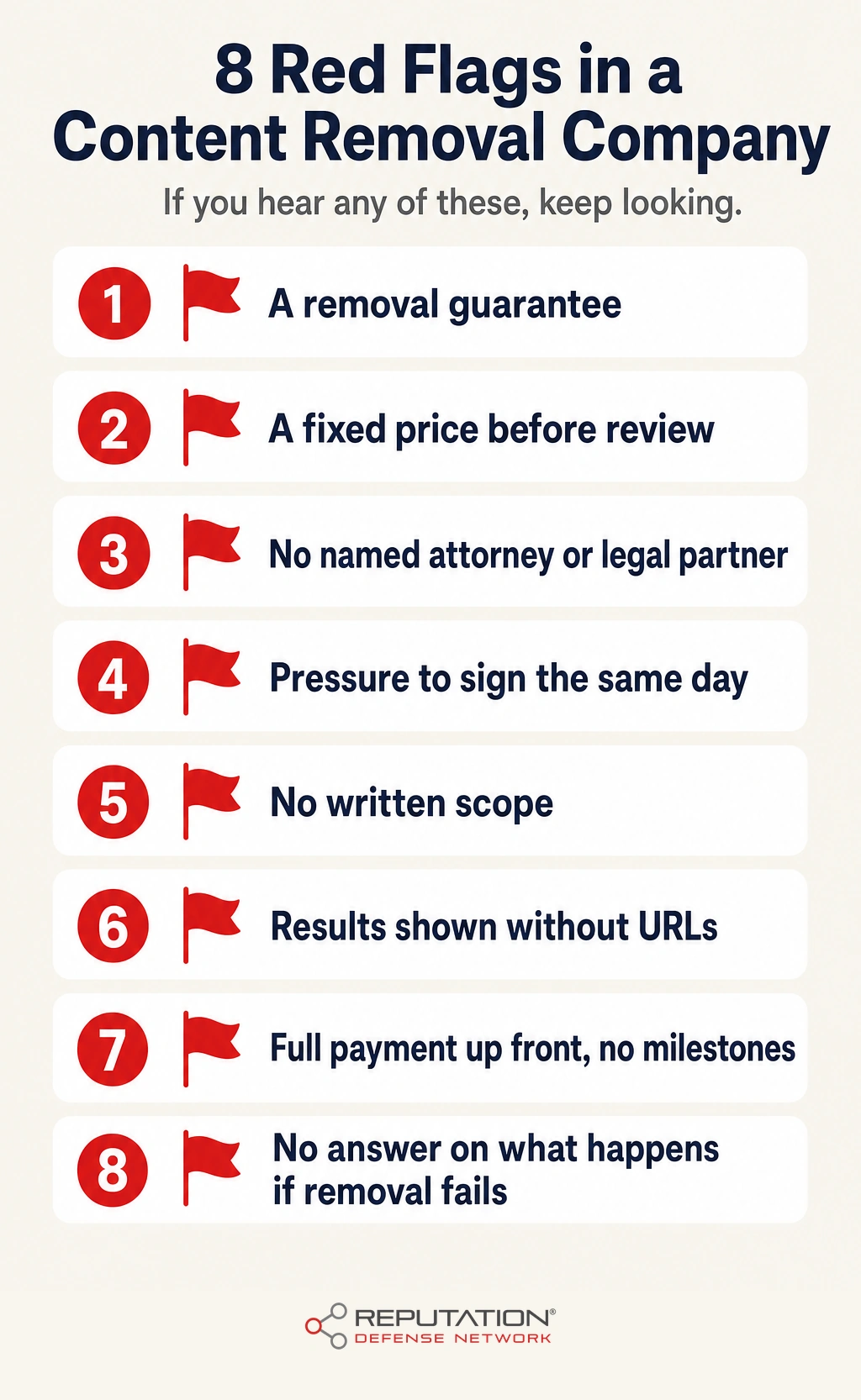
Watch for these warning signs:
- A removal guarantee. No one controls what a publisher, platform, or court decides, so a guarantee means the firm is either overpromising or redefining "removal."
- A fixed price before review. Nobody can price a case without first seeing the URL, the publisher, and the copies.
- No named attorney or legal partner. Without legal capability, the firm cannot pursue defamation claims, court orders, or DMCA notices, whatever the sales page says.
- Pressure to sign the same day. Urgent deadlines serve the seller. A real case will still exist next week.
- No written scope. Without one, you cannot tell what you paid for or if it was delivered.
- Results shown without URLs. Case studies without verifiable details prove nothing.
- Full payment up front with no milestones. Once paid in full, you lose all leverage if work stalls.
- No answer on what happens if removal fails. A firm with a real process has a plan for failure, whether that is a refund, a new route, or suppression.
If you want to see how a firm should answer on each point, review how we handle removal cases.
What Should You Ask a Content Removal Company Before Hiring?
Ask these questions out loud and listen to how directly they get answered:
- "Which route are you going to use on my URL, and why that one?"
- "Who actually does the legal work? Can I get their name?"
- "What happens if it doesn't come down?"
- "Is the result removal at the source, or just from Google?"
- "Can I see the scope in writing before I pay?"
- "How do you handle copies on other sites?"
- "What does monitoring look like after it's done?"
Vague answers to the first three questions are enough reason to end the call.
How Does Reputation Defense Network Handle Content Removal?
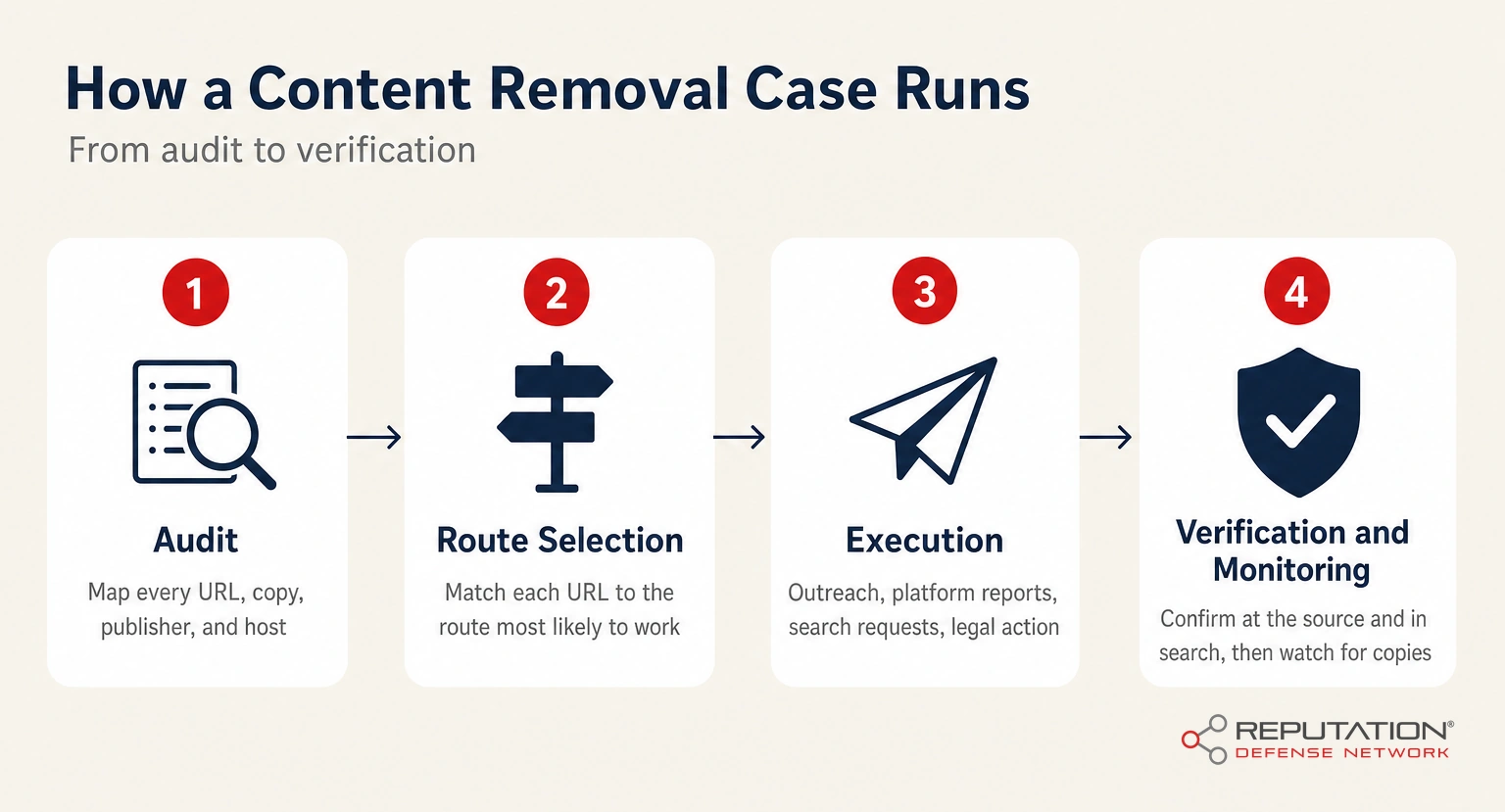
We follow four steps on every case:
- Audit. We map every URL, copy, publisher, and host before quoting anything.
- Route selection. We match each URL to the route most likely to work, starting with the least expensive permanent option.
- Execution. We handle outreach, platform reports, and search requests, and our own legal network handles defamation claims, court orders, and DMCA notices. The legal network is what makes legal removal routes available to our clients.
- Verification and monitoring. We confirm results at the source and in search, then watch for copies and new uploads.
We have resolved more than 7,500 cases, and every one was handled confidentially. For most of our clients, discretion matters over speed, and we treat it that way. Learn more about why clients choose RDN.
Frequently Asked Questions
What are the best services to remove information from the internet?
The best service depends on the route your content needs. For personal information on people search sites, a data broker subscription is usually enough. For news articles, platform content, or defamation, you need a firm that performs outreach and has legal capability. Judge any provider by its written scope, named attorney, and honest answer about what cannot be removed.
What is the difference between content removal and suppression?
Removal takes content down or out of search results, while suppression leaves it online and pushes it lower in results. Removal applies when content breaks a rule, law, or publisher policy. Suppression applies when it does not.
Can content be removed permanently?
Source removal is permanent when the publisher deletes the page and no copies exist. Deindexing is conditional as the page stays live, and the listing can return if the content moves to a new URL or the reason for removal no longer applies. Suppression is never permanent, since the content stays online and rankings change.
Do I need a lawyer for content removal?
Not for platform policy takedowns or publisher outreach, which you or a removal firm can handle. You do need one for defamation claims and court orders. A lawyer adds formal demand letters, subpoenas to identify anonymous posters, and the ability to file suit, which carries weight a request cannot. Learn about our legal network.
How long does content removal take?
It varies by route. Publisher outreach usually takes a few weeks. Platform takedowns and Google requests often take days to a few weeks. DMCA notices move in weeks, while litigation can take months or longer. Suppression typically takes three to twelve months.
Is content removal legal?
Yes. Asking a publisher to unpublish content is a request. It is not coercion, and publishers are free to say no. The legal problem occurs on the other side as some sites publish content specifically to charge for its removal. Mugshot sites are the classic example, and paying them typically invites more of the same.
Talk to Someone Before You Sign Anything
Before you pay any firm, get a straight answer on which route your content needs. We will review your URLs and tell you honestly what can come down, what can only be hidden, and what it should cost. Request a free consultation or learn more about tactical removal service.

RDN is dedicated to helping businesses of all size make informed decisions. We adhere to strict editorial guidelines our content meets and maintains our high standards.
Prefer RDN in your Google results? Add us as a preferred source on Google.
Related Articles
How Much Does News Article Removal Cost? 2026 Pricing
Published on October 8, 2026
By Scott Bates · Reviewed by Lamont S. News article...
Content Removal Services: How They Work and What They Cost
Published on October 7, 2026
By Scott Bates · Reviewed by Lamont S. Content removal...
News Article Removal: What Google Will Actually Delete
Published on October 7, 2026
By Scott Bates · Reviewed by Lamont S. Google will...