
News article removal typically costs between $100 and $50,000 or more, and the removal route is what decides where you land in that span. A single URL taken down under a publisher's own policy appears at the low end, while a court order covering a story syndicated across several outlets will most likely land at the high end.
Most firms quote in one of three ways, using a flat fee per URL, monthly retainer, or pay on success. Knowing what each route costs and what moves online reputation management pricing up or down makes it much easier to compare the quotes you have in front of you.
Key Takeaways
- The route sets the price. Publisher outreach usually runs $500 to $5,000 per URL and platform takedowns $100 to $1,500 per item, while legal routes commonly start near $5,000.
- Syndicated coverage multiplies the cost. A story republished by 15 outlets can mean 15 separate removals, not one.
- Legal routes cost the most and work when nothing else does. Expect $5,000 to $50,000 or more, plus filing and service costs.
- Pay on success shifts risk to the firm and raises the per item price. You pay only for results, but each result costs more than it would under a flat fee.
- A firm that quotes before seeing the URL is guessing. An accurate number requires reviewing the article, its syndication, and the publisher first.
What Is the Average Cost to Remove a News Article?
The cost to remove a news article ranges from roughly $500 for a single URL removed through publisher policy to $50,000 or more for a legal case covering several outlets. Most single article removals land between $1,500 and $7,500. The span is so wide because the route, not the article itself, determines how much work the removal takes.
How Much Does Each Removal Route Cost?
| Route | Typical price range | Timeline | Success likelihood |
|---|---|---|---|
| Publisher outreach | $500 to $5,000 per URL | 2 to 8 weeks | Moderate and highest for outdated or inaccurate stories |
| Platform takedown | $100 to $1,500 per item | 1 to 4 weeks | High when a clear policy violation exists |
| Google deindexing | Free to file; $250 to $1,500 with a firm | 1 to 6 weeks | High for qualifying personal information; low otherwise |
| Legal route | $5,000 to $50,000 or more | 3 to 18 months | High once an order is granted; depends on the claim |
| Suppression | $1,000 to $10,000 per month | 6 to 12 months or longer | Gradual; the article stays online |
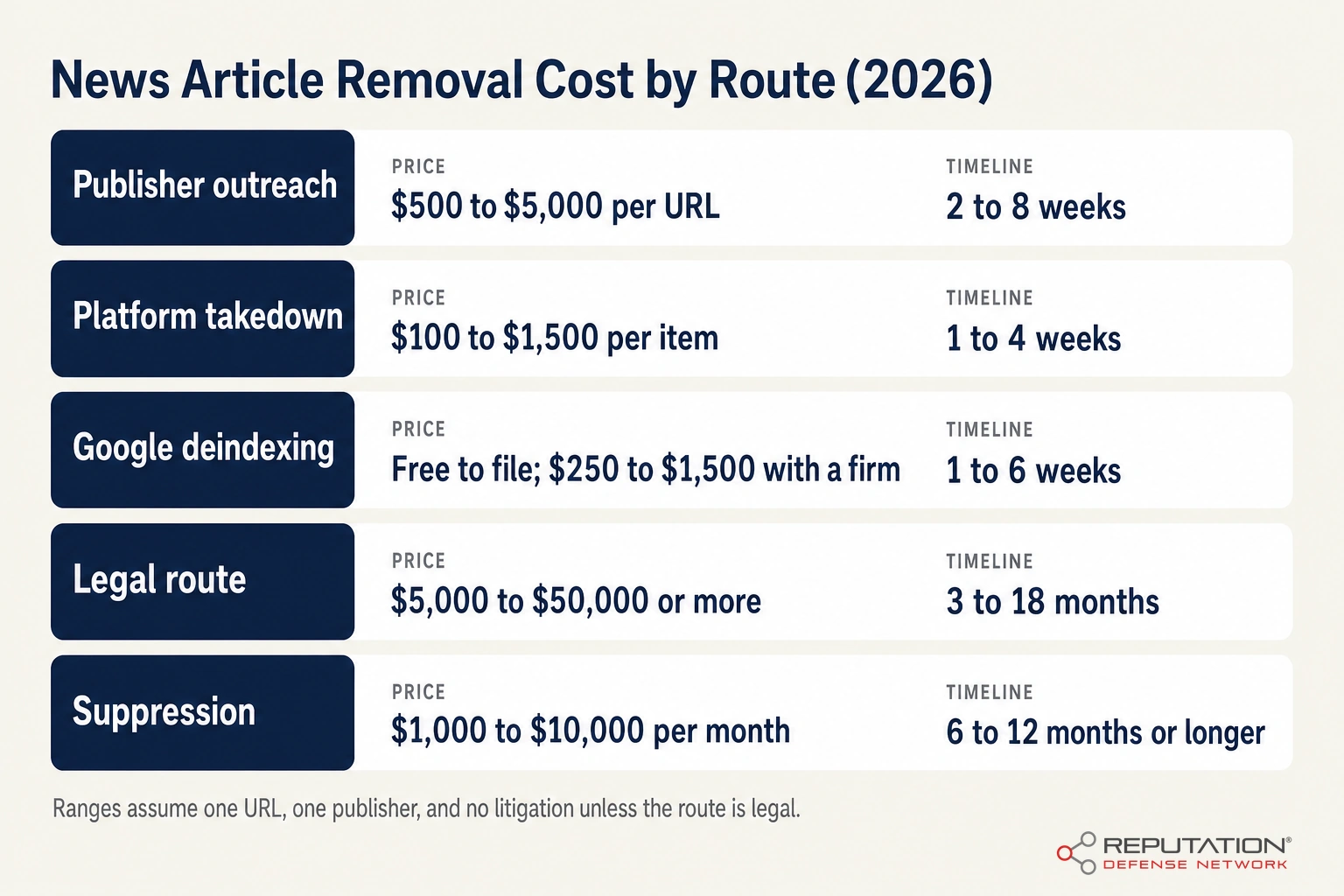
These ranges assume one URL, one publisher, and no litigation unless the route is legal. Syndication, a national outlet, or a contested claim will push any route toward the top of its range.
A free case review gives you a real number for your URL. Request a case review.
Publisher Outreach Pricing
Publisher outreach is the least expensive route and commonly the most effective. The price reflects labor instead of a single email. A reasonable engagement includes:
- Identifying the right decision maker, which is often a standards editor rather than the reporter.
- Reviewing the outlet's published corrections and unpublishing policy.
- Drafting a request supported by documents, such as a dismissal order or proof of an error.
- Following up over several weeks, since first requests are often ignored.
- Proposing fallbacks if full removal is refused, such as an update, anonymization, or a noindex tag.
A firm charging several thousand dollars for one outreach email with no follow up is overcharging. Ask what the fee covers week by week.
If an attorney sends the request instead, expect to pay more, since law firms often set a minimum fee near the top of this range.
Platform Takedown Pricing
Platform takedowns cover policy-based removals from review sites, social platforms, forums, and mugshot sites. They are usually priced per item, from $100 to $1,500 depending on the platform's process.
Pricing scales in a straight line, making twenty listings cost roughly twenty times what one costs. Many platforms are free to petition through their own reporting tools, so the fee is entirely the firm's labor in documenting the violation and following it through. Several states also restrict mugshot sites from charging people to remove booking photos.
Google Deindexing Pricing
Filing a removal request with Google is free. What you pay a firm applies to their knowledge of which Google removal form is appropriate and how to document the claim so it is approved.
If a firm charges heavily to submit a Results About You request for your phone number or home address, it is charging for something you can file yourself in a few minutes.
Keep in mind that deindexing removes a result from Google only. The article stays live on the publisher's site and in other search engines.
Legal Route Pricing
Legal routes are the most expensive because they require an attorney to build and prove a claim, usually defamation or a privacy violation. Attorneys bill in three common ways, as outlined in the American Bar Association's rule on fees:
- Hourly: Billed for time spent on research, drafting, and court appearances. Rates vary widely by market and experience.
- Flat fee: Used for defined tasks, such as a demand letter or an uncontested court order.
- Contingency: A percentage of any money recovered. This is uncommon in removal work because the goal is removal as opposed to damages.
Filing fees, service of process, and records costs sit on top of attorney fees. A court order is expensive because it requires proof, time, and sometimes identifying an anonymous author.
It is also sometimes the only thing that works, since many publishers and search engines act on a valid order after refusing every informal request. Our legal network connects clients with attorneys who handle these cases.
Suppression Pricing
Suppression is billed as a monthly retainer, not a one-time fee. Suppression works by publishing and strengthening other content until that content outranks the article, which requires content creation, profile building, links, and ongoing maintenance.
Most engagements run 6 to 12 months, and a national outlet ranking for your name can take longer. Budget for the full engagement instead of comparing monthly fees alone.
Learn more about search control and the difference between removal and suppression.
How Do Reputation Management Companies Charge?
Most content removal services use one of three pricing models. Each one suits a different kind of problem.
1. Flat Fee Per URL
- How it works: You pay a set price for each URL, agreed before work begins.
- Who it favors: Clients with a defined problem and a known number of URLs. You know the total cost up front.
- What should be in scope: Research, outreach or filing, follow up, and confirmation that the content is gone. Removal again after a repost at a new URL is typically excluded.
- Question to ask before signing: What happens if the same content reappears at a new URL?
2. Monthly Retainer
- How it works: You pay a recurring monthly fee for ongoing work.
- Who it favors: Suppression campaigns and ongoing monitoring, where the work does not have a single finish line.
- What it should buy: Defined deliverables, such as a set number of published assets, profiles, and ranking reports each month, rather than a vague count of hours.
- Watch for: Open ended terms with no minimum deliverables and no exit point.
- Question to ask before signing: What does month six look like if nothing has moved?
3. Pay on Success
- How it works: You pay only when the agreed result is achieved.
- Who it favors: Clients who want to limit risk. It is the most marketed model and the least understood. The per item price is higher because the firm carries the risk of failed attempts.
- Where disputes happen: The definition of success. Removal from the publisher's site, deindexing from Google, and an update to the article are three different outcomes.
- Question to ask before signing: What counts as success, in writing, and does deindexing count?
How Does Reputation Management Pricing Differ for Individuals and Businesses?
Reputation management pricing depends more on scope than on whether the client is a person or a company. Still, the two usually look different in practice.
A personal issue can involve one name and a small number of URLs. The work may be a single removal or a short suppression campaign. A business, executive, or multiple location brand usually involves more:
- Branded searches across several keyword variations.
- Review profiles on multiple platforms.
- News coverage across several outlets.
- Multiple stakeholders, such as executives, board members, and the company itself.
- Ongoing monitoring after the initial work is done.
As a general benchmark, the average cost of online reputation management for an individual commonly falls around $500 to $5,000 per month for ongoing work. Business and executive campaigns commonly run $3,000 to $20,000 or more per month. Treat these as broad market figures only. A business with one inaccurate article may pay less than an individual whose name ranks alongside a widely syndicated story.
What Affects the Cost of News Article Removal?
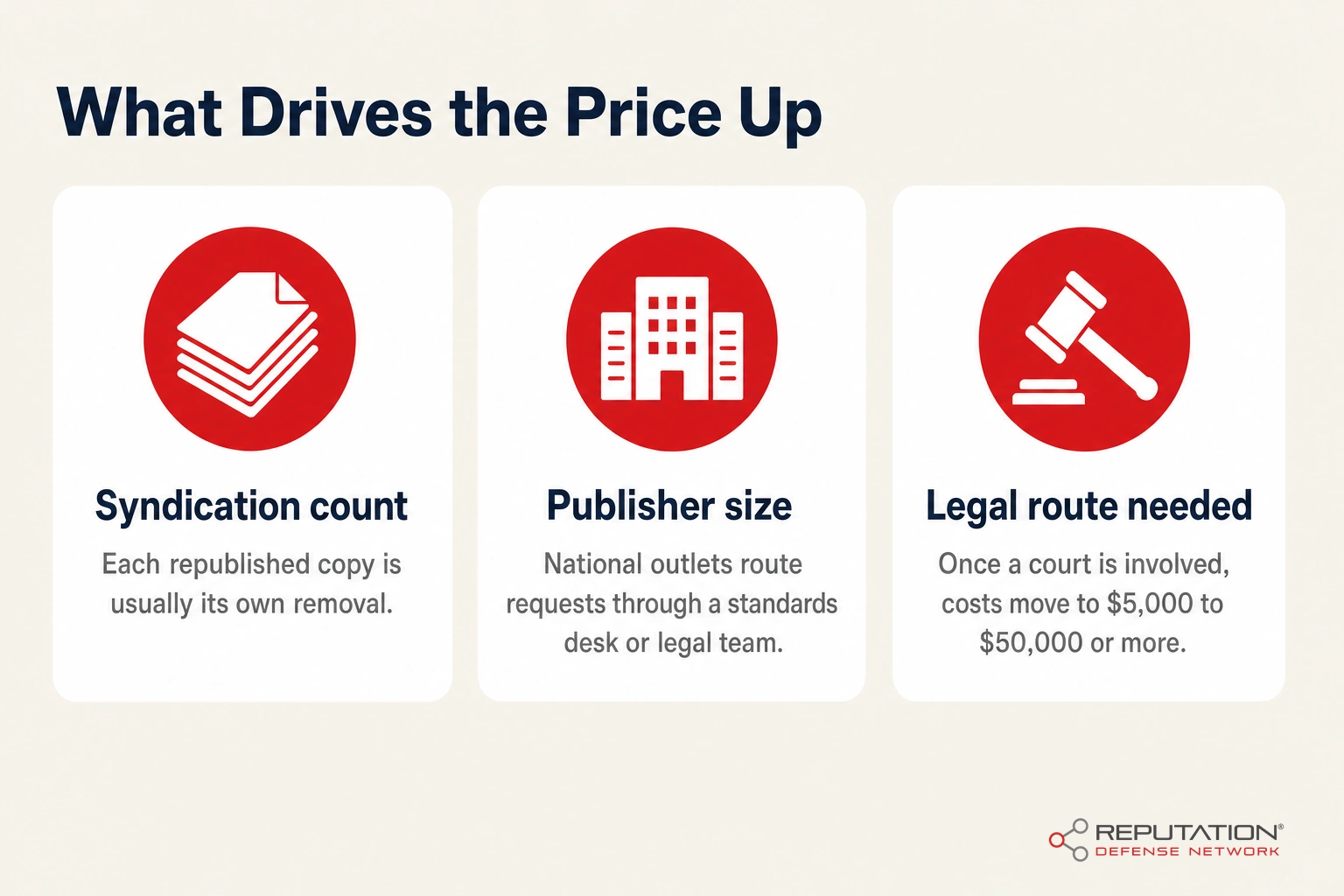
- Syndication count. Each republished copy is usually its own removal. A wire story picked up by 40 local news sites costs much more than one original article.
- Publisher size and reach. A regional weekly editor may decide alone, while a national outlet routes requests through a standards desk or legal department.
- Whether the content is accurate. Inaccurate reporting has a correction path. Accurate reporting is seldom removed and can shift the plan toward suppression.
- Whether a legal route is needed. Once an attorney and a court are involved, the cost moves into the legal range of $5,000 to $50,000 or more.
- How old the article is. An eight-year-old story about dismissed charges is a stronger unpublishing candidate than a story from last month.
- How many search terms it ranks for. An article that appears for your name, your name plus your city, and your company name is harder to address than one that ranks for a single term.
- Whether your name has competing content. If you already have a professional profile, a personal site, and recent press, suppression moves faster and costs less.
What Should Be Included in an Online Reputation Management Quote?
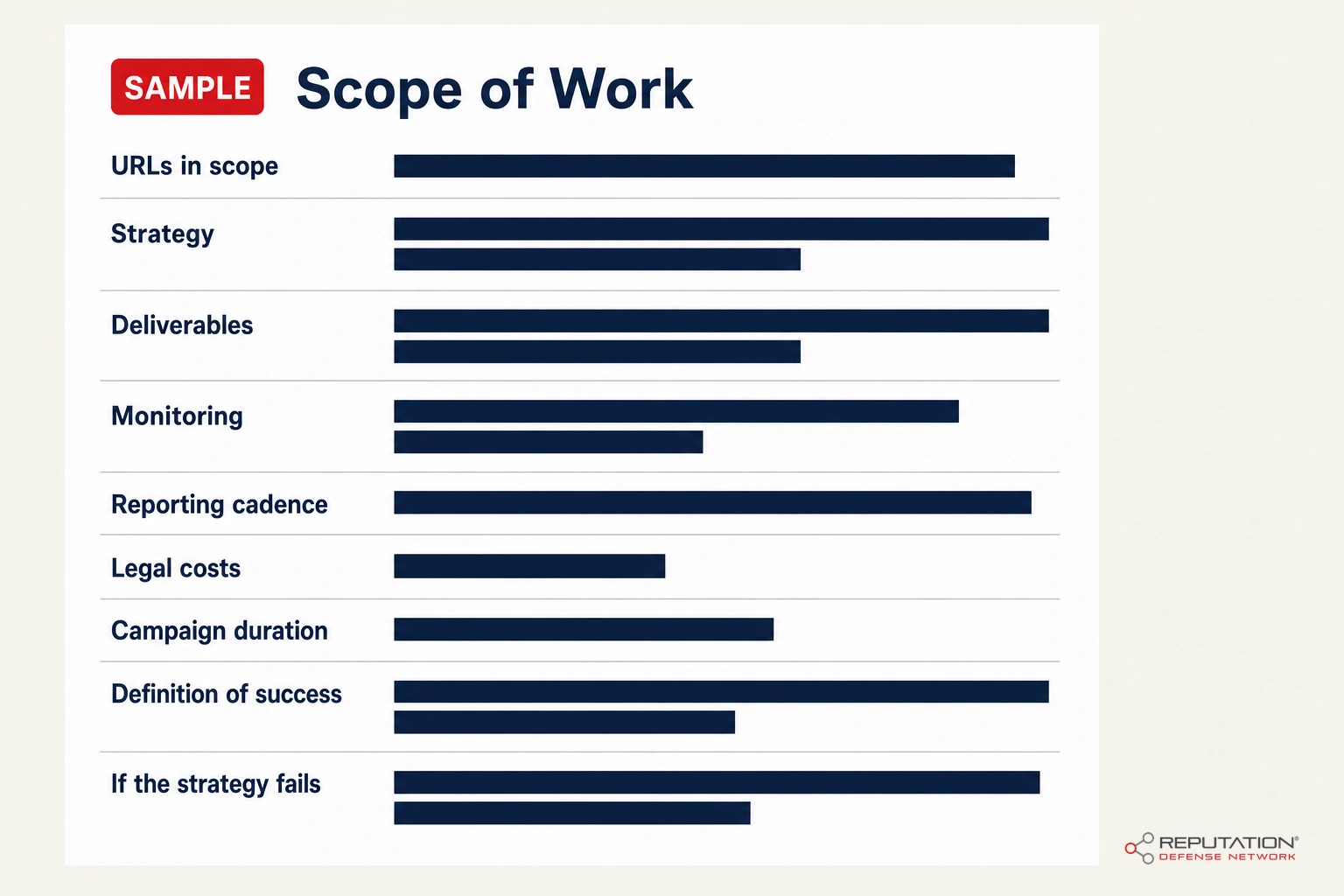
Two quotes at very different prices may cover very different scopes. Compare what each proposal includes, not the monthly fee alone. A complete quote should state:
- The URLs or search terms in scope, listed individually.
- The strategy, whether removal, suppression, or a mix, and why.
- Deliverables, such as outreach attempts, filings, or published assets.
- Monitoring, including how long it lasts and what it watches for.
- Reporting cadence, such as weekly updates or a monthly ranking report.
- Legal costs, if applicable, with attorney fees separated from firm fees.
- Campaign duration, with a start date and a review point.
- What counts as success, defined in writing.
- What happens if the initial strategy fails, including any fallback plan and its cost.
If a proposal leaves out several of these items, ask for them in writing before you compare its price with another firm's.
What Should You Never Pay For in Reputation Management
- Payment to an extortion site. Some sites post damaging content and then charge to take it down. Paying funds the site and invites the content to be reposted elsewhere.
- A removal guarantee. No firm can guarantee removal of accurate reporting, because the publisher makes that decision. The FTC's advertising guidance requires that claims like these be truthful and supported.
- A retainer with no written scope. If the contract does not list deliverables, you have no way to measure what you are paying for.
Is Removal Worth the Cost?
The useful comparison is the reputation management cost against what the article is already costing you. Common examples include a client who backs out after searching your name, a job offer withdrawn after a background search, or a lender or landlord who asks follow up questions you would rather not answer.
The cost of leaving the article up also compounds, because a news article that ranks for your name can stay on the first page for years. Each search is another chance for it to affect a decision.
A removal that costs a few thousand dollars once is often small next to a single lost contract or salary offer, but the decision should rest on your own situation and the route your article requires.
How Do You Get an Accurate Quote for News Article Removal?
A case review replaces a range with a specific number. It looks at:
- The URL: The article itself, its age, and if it contains errors.
- The syndication footprint: Every site that has republished or excerpted the story.
- The publisher: Its size, its unpublishing policy, and how it has handled past requests.
- The route: Which removal path is most likely to work, and which fallback applies if it does not.
With those four answers, a firm can quote a price for your case as opposed to a market estimate. Learn more about how we remove negative news articles, or request a free case review.
Frequently Asked Questions
How much does it cost to get something removed from the internet?
Removing content from the internet typically costs between $100 and $50,000 or more. A single policy based takedown is at the low end, and a legal case covering multiple outlets lands at the high end. The removal route is the main variable.
Can I remove a news article for free?
Yes, in narrow cases. You can sometimes do it yourself when the page is outdated, when it clearly violates a platform's policy, or when it contains a factual error a regional editor is willing to fix. Google's removal tools are also free. Free stops working when the publisher refuses, the story is syndicated widely, or the reporting is accurate.
Why do removal quotes vary so much?
The route determines the work, and legal routes cost many times more than outreach. Syndication multiplies the number of URLs that need attention. Legal exposure, such as a publisher with its own counsel, adds time and cost.
Does reputation management cost more than removal?
Over time, it usually does. Removal is a project with a defined end, while suppression is closer to a subscription billed monthly. Over three years, a suppression retainer usually costs more than a single removal. That is the tradeoff for addressing content that cannot be taken down.
Do removal companies offer refunds?
It depends on the contract. Some firms structure engagements around milestones, some offer pay on success, and others bill for work performed regardless of outcome. The written scope of work determines what you are entitled to. Get the refund terms and the definition of success in writing before you pay anything.
Get a Quote for Your Article
The first step is small. Send us the URL, and we will review the article, its syndication, and the publisher, then give you a straight number for your case. Request your free quote.

RDN is dedicated to helping businesses of all size make informed decisions. We adhere to strict editorial guidelines our content meets and maintains our high standards.
Prefer RDN in your Google results? Add us as a preferred source on Google.
Related Articles
How Much Does News Article Removal Cost? 2026 Pricing
Published on October 8, 2026
By Scott Bates · Reviewed by Lamont S. News article...
Content Removal Services: How They Work and What They Cost
Published on October 7, 2026
By Scott Bates · Reviewed by Lamont S. Content removal...
News Article Removal: What Google Will Actually Delete
Published on October 7, 2026
By Scott Bates · Reviewed by Lamont S. Google will...