
Most requests to remove a news article are declined. To get a news article removed, write to the section or managing editor, not the reporter, attach a document that proves your point, and ask for the smallest change that fixes the harm. Editors who will not delete a story often correct it, add an update, or remove your name.
Editors are most often persuaded by one of four arguments: the article contains a factual error, the case was dropped or dismissed, publication creates a safety risk, or the story is old and the matter has since been resolved.
Key Takeaways
- Write to the editor, not the reporter. Editors have the authority to change a published story, but reporters usually do not.
- Ask for the smallest change that solves the problem. A correction or an update is far easier to approve than a deletion.
- Factual errors and resolved charges are your strongest arguments. Attach the document that proves the point.
- Many newsrooms now have written update policies. Look for one before you write, and frame your request to fit it.
- Never offer money. It ends the conversation immediately and can become a story of its own.
Will a Newspaper Actually Remove an Article?
Sometimes, but full removal is rare. Most newspapers decline to unpublish accurate reporting as a matter of policy. A correction, an update explaining how a case ended, or removal of your name from the story is far more achievable. The requests that succeed usually ask for the smallest change that fixes the harm.
The reasoning is worth understanding, because a reader who respects it writes a better request. Newspapers treat their archives as part of the historical record, and press freedom organizations commonly hold that removal decisions belong to editors.
The law points the same way, and in most cases, a publisher cannot be required to take down accurate reporting it has already published. Orders such as expungements apply to government records rather than news coverage.
That does not mean editors ignore the people they cover. The Society of Professional Journalists Code of Ethics asks journalists to weigh the lasting reach of online publication and to "provide updated and more complete information as appropriate." That principle is the opening your request should use. You are not asking an editor to erase history. You are asking them to make the record complete.
Who Do You Contact to Get a News Article Removed?
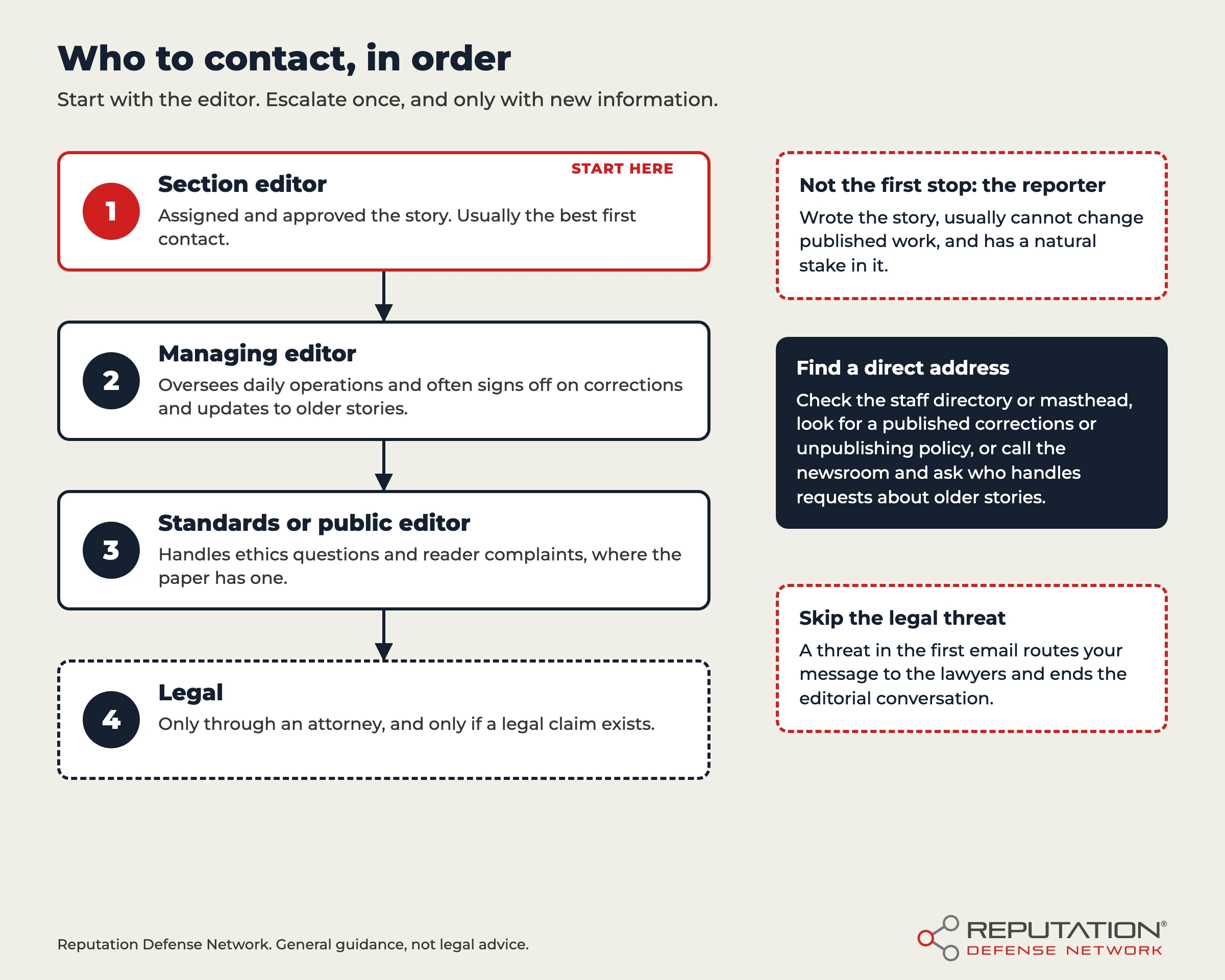
If you are wondering who to contact to remove a news article, start with the editor who oversees the section where the story ran. Newsrooms divide responsibility in fairly predictable ways:
- Reporter: Wrote the story. Reporters do not typically have authority to change published work and are understandably protective of it.
- Section editor (metro, city, courts, or business editor): Assigned and approved the story. This is usually the best first contact.
- Managing editor: Oversees daily operations and frequently signs off on corrections and updates to older stories.
- Standards editor or public editor: Handles ethics questions and reader complaints at larger outlets. If the paper has one, this role is usually the one that reviews unpublishing requests.
- Legal counsel: Reviews legal threats. A request routed here is prone to leave the editorial conversation entirely.
Start with the editor as opposed to the reporter for a simple reason. The editor can approve a change, and the editor is one step removed from the original reporting, so they can weigh your request on its merits.
Finding the Right Address
Many news sites list only a generic tips inbox. To find a direct contact:
- Check the staff directory, masthead, or "About us" page.
- Look for a published corrections, ethics, or unpublishing policy. These pages often name the person or form that handles requests.
- Search the site for a dedicated request form. The Boston Globe, for example, built a Fresh Start application that asks for an explanation and supporting legal documents.
- Call the main newsroom line and ask who handles corrections or requests regarding older stories.
The Escalation Path
- Section editor
- Managing editor
- Standards editor or public editor, where one exists
- Legal, only through an attorney and only if a legal claim exists
What Reasons Will Get a News Article Removed?
For each argument, you will find what it is, the evidence to attach, the outcome it usually produces, and the specific request to ask for.
1. The Article Contains a Factual Error
A factual error is the strongest argument, and it is the one newsrooms are ethically obligated to address. The key is separating a factual error from unflattering framing. A wrong age, a misstated charge, or an incorrect employer is an error. A tone you dislike or a quote you regret is not.
- Evidence to attach: A document that proves the correct fact, such as a court record, a corrected filing, or an official record.
- Usual outcome: A correction and a note explaining what changed.
Ask for a correction and an update note, not deletion.
2. The Case Was Dropped, Dismissed, or Expunged
An arrest story with no follow up is among the most common reasons people ask for removal. The original story reports a charge, and nothing tells readers how it ended. Many newsrooms have policies for exactly this situation. The Associated Press, for instance, stopped naming suspects in brief stories about minor crimes in 2021 because those stories seldom receive follow up coverage.
- Evidence to attach: The dismissal order, the acquittal, or the expungement order. Our guide to court records explains how to obtain these documents.
- Usual outcome: An update appended to the original story, which most outlets will add even when they will not unpublish.
Ask for an update stating the outcome of the case, placed at the top of the article.
3. Publication Creates a Safety Risk
Newsrooms take genuine safety concerns seriously. These include domestic violence, stalking, credible threats, and stories that published a home address or identifying photo. The request here is usually narrower than the story itself.
- Evidence to attach: A protective order, a police report, or documentation from law enforcement. This evidence strengthens a request substantially.
- Usual outcome: Removal of the specific detail that creates the risk.
Ask for removal of the address, photo, or identifying detail, not the entire story.
4. The Article Is Old and No Longer Newsworthy
Age is the argument most people want to make, and it is the weakest of the four when it stands alone. Time alone rarely moves an editor, because old stories are still part of the record. What works is pairing age with a resolved outcome, such as a completed sentence, a dismissed charge, or a business that has since closed.
- Evidence to attach: Anything showing the situation has been resolved.
- Usual outcome: Often a decline. A newsroom with a formal policy may add an update or limit search visibility.
Ask for an update or name removal, with age as supporting context. If age is your only argument, suppression may be the more realistic route.
What Should You Ask the Newspaper to Change?
The most effective request is usually the narrowest remedy that solves your problem. Match the ask to the harm instead of defaulting to deletion. Here are the realistic options, from least to most disruptive for the newsroom:
- Correct a factual error. The easiest yes, when the evidence is clear.
- Append an update or outcome. Common for dismissed or reduced charges. An editor's note at the top of the page gives readers context immediately.
- Remove or anonymize a name or sensitive detail. Some newsrooms replace a name with a neutral description, which keeps the story intact while removing the personal harm.
- Remove a photo or address. Typical for safety concerns.
- Add a noindex directive. The story stays on the newspaper's site, but a noindex tag tells Google to drop the page from its search results once Google recrawls it. Google notes that other search engines may treat the tag differently. The Southeast Missourian, for example, adopted a policy of blocking crime reports from search engines after six years.
- Fully unpublish the page. The rarest outcome, generally reserved for legal problems, serious safety risks, or policies built for specific cases.
Which of these a newspaper will consider depends on its editorial policies and the facts of your case. None of them is guaranteed.
How Do You Write a Request to Remove a News Article?
Keep the request short, specific, and calm. Editors receive many of these, and long messages get skimmed. Replace every bracketed field before sending.
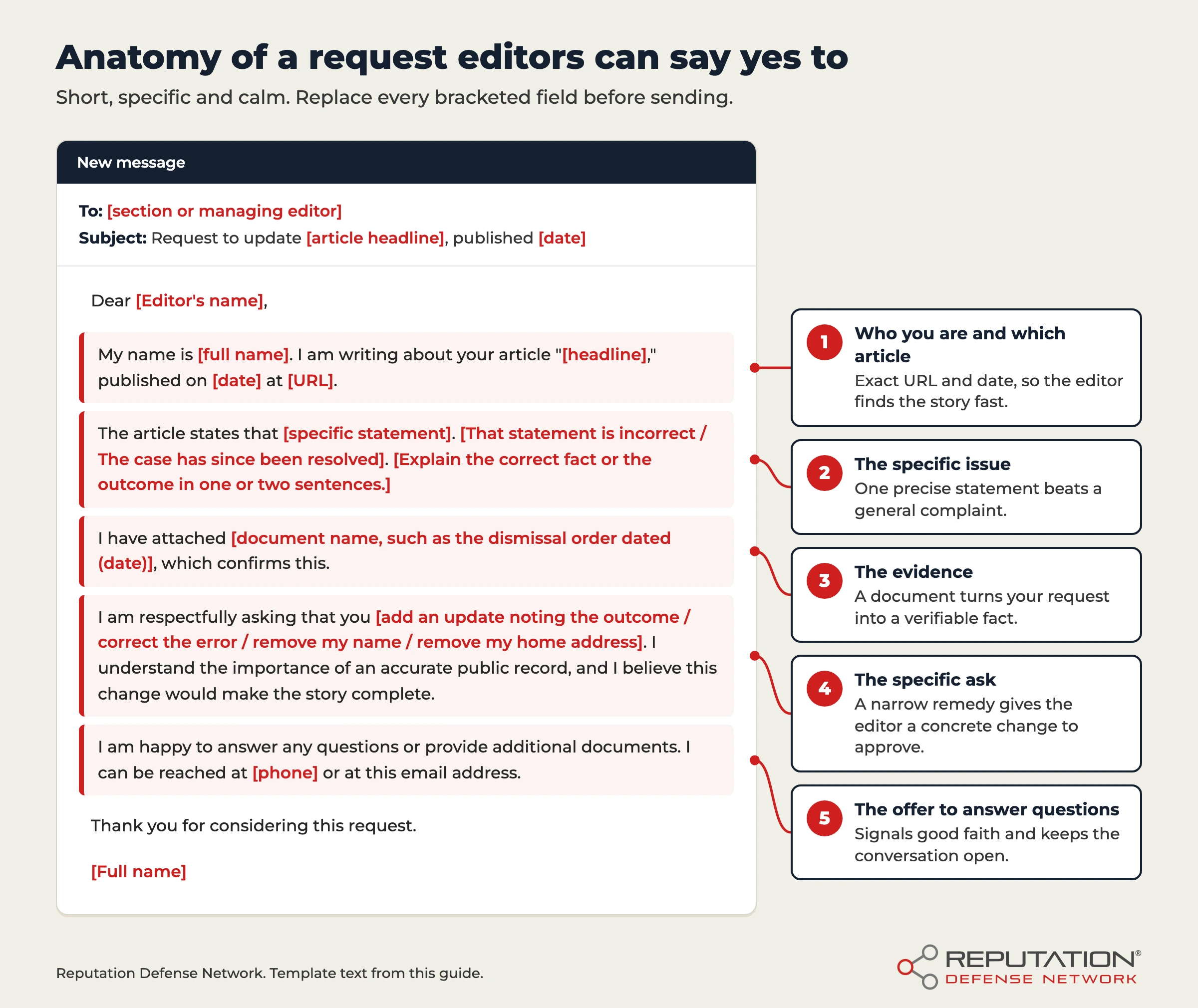
Subject: Request to update [article headline], published [date]
Dear [Editor’s name],
My name is [full name]. I am writing about your article “[headline],” published on [date] at [URL].
The article states that [specific statement]. [That statement is incorrect / The case has since been resolved]. [Explain the correct fact or the outcome in one or two sentences.]
I have attached [document name, such as the dismissal order dated (date)], which confirms this.
I am respectfully asking that you [add an update noting the outcome / correct the error / remove my name / remove my home address]. I understand the importance of an accurate public record, and I believe this change would make the story complete.
I am happy to answer any questions or provide additional documents. I can be reached at [phone] or at this email address.
Thank you for considering this request.
[Full name]
Why Each Part is There
- Who you are and which article: Editors need the exact URL and date to locate the story quickly.
- The specific issue: One precise statement is more persuasive than a general complaint about the coverage.
- The evidence: A document turns your request from an opinion into a verifiable fact.
- The specific ask: Naming a narrow remedy gives the editor a concrete change to approve.
- The offer to answer questions: It signals good faith and keeps the conversation open.
Free download: Newspaper Update Request TemplateThe letter from this guide as a one-page PDF, with the four arguments and the follow-up checklist.
What Mistakes Get a Removal Request Rejected?
- Threatening litigation in the first email. It routes your message to the legal department and ends the editorial conversation.
- Offering money. It does not work, it damages your credibility, and it can end up in a story about the request.
- Writing to the reporter instead of the editor. The reporter usually cannot approve the change and has a natural stake in the original work.
- Asking for full deletion when a correction would solve it. An oversized ask gives the editor an easy reason to say no.
- Sending it from an anonymous address. Editors cannot verify an anonymous request, so they rarely act on one.
What Can You Do If a Newspaper Refuses to Remove an Article?
A declined request is common, and it does not necessarily signify the end. Work through these steps in order.
- Escalate once, with new information. Write to the standards editor or managing editor, but only if you have something the first editor did not see, such as a new court document. Repeating the same argument to a higher editor rarely changes the answer.
- Check whether a Google route applies. If the newspaper changed the article, for example by removing your name, Google may still show the old version in search results. Google's Refresh Outdated Content tool lets anyone ask Google to update results for pages that have changed. It will not work if the information is still on the live page. Google also maintains separate removal policies for certain personal information; check current Google Search Help to see whether your situation qualifies.
- Assess whether a legal claim exists. A false and damaging statement may support a defamation claim, but deadlines are short and vary by state. An attorney can tell you whether a claim is viable. Our legal network can connect you with counsel.
If the story was syndicated, each copy on another site needs its own request to its own publisher, which is where most people stop trying alone. Our news article removal hub explains how syndication affects removal.
If your story has spread across several outlets, or you are not sure which route fits your case, our team can review it and tell you what is realistic.
When Should You Hire Help to Remove a News Article?
Many people handle a single request to a local paper on their own, but these three situations are more difficult to manage alone:
- Syndicated coverage across many outlets. Each copy needs its own contact, request, and follow up.
- A national publisher. Larger newsrooms have more layers of review and more formal processes.
- Anything that needs a legal route. Legal claims involve deadlines and evidence standards that are easy to get wrong.
At RDN, outreach is handled by a team that makes newspaper removal requests every day and knows how escalation works inside different newsrooms. We have worked on 1,000+ news article cases. Learn more about our news article removal and tactical removal services.
A professional came to us after a local news story about their arrest started ranking first for their name. The charges were dismissed months later, but the newspaper never updated the story, so it still read as though the case was open.
In a scenario like this, the request to the newspaper is only one part of the work. A review of the situation found:
- The original article was accurate when published but missing the dismissal.
- A booking photo and home address included in the story.
- Copies of the article on aggregator sites that answered to different publishers.
- A Google result that still showed the old headline and snippet.
In every case, we begin with the narrowest request the facts support. In this instance:
- The managing editor received a short request for an update stating the dismissal, with the dismissal order attached.
- A separate request asked the newspaper to remove the booking photo and home address.
- Each aggregator copy received its own request to the site that published it.
- Once the newspaper updated the page, a Refresh Outdated Content request asked Google to update the old snippet.
In a scenario like this, if the newspaper declines, we escalate once with any new documentation and plan suppression for the copies that stay live.
Frequently Asked Questions
Can I ask a newspaper to remove an article about me?
Yes, but treat it as a request as opposed to a demand. Full removal happens occasionally. The more likely outcomes, in order, are a correction, an update explaining how the matter ended, removal of your name or a sensitive detail, limited search visibility, and, least often, full removal.
Do newspapers have to remove false information?
Newspapers have a strong ethical obligation to correct false information but no general legal obligation to delete it. A correction fixes the record while keeping the story, and that is what most newsrooms will offer. Whether a false statement creates a legal claim depends on the facts and your state's law, so speak with an attorney before relying on that route.
Should I threaten to sue?
Not in a first email. A legal threat usually moves your message to the paper's lawyers and ends any editorial conversation about an update or correction. If you believe you have a genuine defamation claim, have an attorney evaluate it and send any formal letter on your behalf.
How long should I wait for a reply?
Allow at least two weeks before following up. Your follow up should be short: restate the article, the specific ask, and the attached evidence, and ask whether the editor needs anything else. Silence is common in busy newsrooms and is not the same as a no. If a second message goes unanswered, try the managing editor.
Can I get my name removed instead of the whole article?
Yes, and it is one of the most commonly granted requests. The newspaper replaces your name with a neutral description, and the story remains intact for the public record. Editors find this easier to approve because the reporting itself does not change. Once the name is gone, Google's outdated content tool can help update search results that still show it.
Can I ask a newspaper to keep the article online but remove it from Google?
Yes, though the publisher does not have to agree. A noindex tag is often the most realistic way to remove a news article from Google. A publisher can add a noindex tag to its own page, which keeps the story on its site but out of Google's results. A Google policy based removal is different: Google decides under its own eligibility rules, and the page owner is not involved.
Download the Request Template
Download the free request template and adapt it to your situation before you contact the newspaper. If your request to remove a negative news article is declined, visit our news article removal hub or contact our team to talk through your options for removing a news article from the internet.

RDN is dedicated to helping businesses of all size make informed decisions. We adhere to strict editorial guidelines our content meets and maintains our high standards.
Prefer RDN in your Google results? Add us as a preferred source on Google.
Related Articles
How to Remove a Mugshot From Google: 7 Proven Steps
Published on November 18, 2026
By Scott Bates You can usually remove a mugshot from...

Google Results About You: What It Removes, What It Misses
Published on November 18, 2026
By Scott Bates Google will remove certain search results about...
How to Remove Court and Arrest Records From the Internet and Google
Published on November 18, 2026
To remove court records from the internet, seal or expunge...