
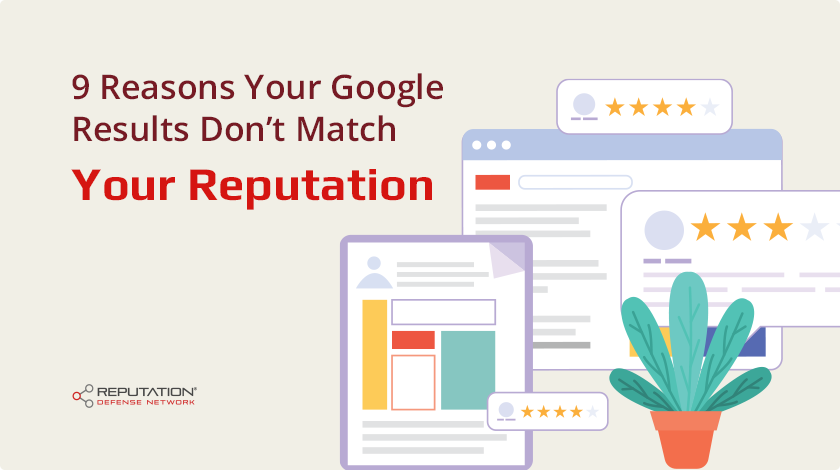
Google results often don’t match reputation because search engines rank for authority, recency, and engagement, not fairness. Negative content spreads faster and single incidents outrank years of good work, as personalization changes what each person sees. The fixable part is having little owned content online. Strengthening that content is what actually shifts results.
Search your own name or your company’s name, and the results can feel wrong and outdated, unfair even. Sometimes they read like they belong to a completely different person or business. If that gap between what Google shows and what you know to be true feels confusing, you are not imagining it, neither are you alone.
There are several real reasons this disconnect happens, and some of those reasons are fixable. Others are simply how search engines work, and no amount of frustration will change the underlying mechanics.
The right response depends partly on what is causing the problem, be it a negative news article, unfair review, or something else entirely. Nine common factors can generally explain that gap, and each affects individuals and businesses in slightly different ways.
1. Search Engines Rank for Authority and Recency
Google’s ranking systems are built to identify pages that are authoritative and relevant as well as current. They are not built to decide what is fair or representative of who you are.
A single article published by a major news outlet can outrank your own company website simply because that news domain has earned more trust signals over time and has more backlinks, traffic, and history.
A well established, respected business can find itself outranked in its own name search by a story that ran once, years ago, on a site with more domain authority. It is not a reflection of accuracy but instead points to how Google’s ranking systems weigh signals that have nothing to do with fairness.
2. Negative Content Can Generate More Engagement
Controversial or negative content typically gets more clicks, shares, and even inbound links than neutral or positive content. The engagement feeds directly into how search engines judge a page’s relevance and popularity.
Over time, an article or post that generated strong reactions keeps climbing because people interacted with it more. A glowing review or a positive news mention rarely gets the same volume of shares, so it rarely earns the same ranking boost., and the imbalance compounds the longer the content sits online.
3. A Single Incident Can Outrank Years of Steady Work
Moments like a bad quarter or controversial decision can generate coverage from journalists, customers, or commentators. Meanwhile, years of steady, reliable work rarely generate any content at all, because there is nothing unusual to write about.
Search engines can only rank what actually exists online, so if the only substantial content regarding you or your business is tied to one negative event, that is what will come up, simply because it is the only thing anyone bothered to publish. The absence of positive coverage is a content gap.
4. You Might Be Seeing Results for Someone Else
If you share a name with another person or your company shares a name with another business, results for that other entity can blend into your own search results. Common names make this even more likely, and it can be genuinely difficult to untangle who is who from the search results page alone.
If you suspect mistaken identity is part of the problem, it helps to understand how personal reputation management answers this specific issue, since separating your identity from someone else’s online footprint requires a different strategy than addressing content that is actually about you.
5. Personalization Means Not Everyone Sees What You See
Search results will not be identical for every person who types the same query. Your location, device, browsing history, and even which search engine you use, Google versus Bing versus others, can all shift what appears and in what order.
This explains a common source of confusion when two people search the exact same name and see two different sets of results. Neither person is wrong. Google’s personalization and localization systems are simply tailoring results based on signals unique to each searcher, which means there is no single, universal version of your search results to point to.
6. Data Aggregator Sites Rank Well Regardless of Accuracy
People search sites and data broker platforms are built specifically to rank well for names. Their entire structure, page format, and internal linking exist to maximize search visibility. That does not mean the information they display is current, complete, or even correct.
These sites typically pull and present outdated addresses, old employers, or inaccurate associations, and yet they can still rank near the top of a name search simply because they are optimized for exactly that purpose. Seeing one of these results near the top means the site is good at being found and not necessarily anything more.
7. Reviews Reflect a Vocal Minority
Review platforms attract a specific kind of participation, so people who had a frustrating experience are far more likely to post than people who had a satisfactory one. That means the reviews visible on a search results page will typically skew negative, even when the overall customer experience is largely positive.
It creates a distorted picture for businesses in particular, where a handful of vocal complaints can outweigh hundreds of quiet, satisfied customers who never left a review at all. If review skew is shaping how your business appears online, it is worth understanding how business reputation management addresses the pattern directly and does not wait for it to correct itself.
8. Outdated or Cached Pages Can Still Show Up After a Correction
A page that has since been updated, corrected, or removed entirely can still appear in search results for a period of time, and that happens because of caching and indexing delays.
Google does not recrawl and refresh every page instantly, so what you are seeing may not accurately reflect what is currently live on that site. Since the underlying problem may already be resolved on paper, this can be one of the most frustrating reasons for inaccuracies, until Google’s systems catch up.
9. There's Little or No Content Online That You Actually Control
If the only content ranking for your name or your company is third party news coverage, reviews, or directory listings, there is nothing to balance it out. Search engines cannot rank content that does not exist, so an absence of owned, authoritative content leaves the field open to whatever else is out there.
Here, ranking mechanics, engagement bias, and personalization, become less relevant, and the real issue becomes evident. Understanding how search control works can mean the difference between accepting an unfair search presence and actively shaping it.
Is the Problem a News Article or a Review?
The right response depends heavily on which type of content is causing the mismatch. A negative news article is difficult to remove outright as outlets rarely take down published stories, and legal removal is the exception instead of the rule.
The more realistic path is suppressing a negative news article by building and strengthening owned, authoritative content that can outrank it over time. A negative review works differently because platforms have reporting mechanisms, and removal is genuinely possible when a review violates platform guidelines or is factually false.
Addressing negative reviews usually starts with platform reporting and active review management, instead of content building, since the levers available are different. Knowing which category applies to your situation changes where you should spend your time and effort first.
How to Check What's Actually Showing Up
Before deciding what kind of help you need, it helps to see your search results clearly, without the noise of personalization.
- Search your name or your company’s name in an incognito or private browsing window, so your own history and location are not shaping the results.
- Review the top 10 to 20 results, and go past the first page since the full picture usually takes more than a handful of links.
- Check the autocomplete suggestions that appear as you type, since these often reveal what people frequently search alongside your name.
- Look for a Knowledge Panel, which is the box that sometimes appears alongside search results, and check if the information in it is accurate.
A well executed self check gives you a factual baseline instead of a general impression, which makes it much easier to identify what truly needs attention.
Ongoing reputation monitoring can extend and enhance this same process so changes get flagged as they happen, and aren’t discovered months later.
When to Bring in a Professional
Some reputation gaps are simple enough to address on your own, while others are not, and recognizing the difference early can save a significant amount of time and frustration. Consider bringing in a professional when:
- The gap involves a mix of causes as opposed to one clear, isolated issue.
- The content spans multiple sites, platforms, or formats, making a coordinated response difficult to manage alone.
- There is a mistaken identity issue that is hard to untangle without deeper investigation into who owns which content.
When the situation is layered or spread across many sources, professional reputation consulting can help identify the actual cause and build a plan around it, instead of treating every symptom the same way.
Frequently Asked Questions
A few common questions come up once people understand why this gap exists in the first place.
Can I ask Google directly to fix inaccurate results?
In limited cases, yes. Google allows requests for removal of certain categories of content, such as personal information that poses a safety risk, but it generally does not remove content simply because it is unflattering or outdated. Most fixes come from addressing the source content or building stronger competing content.
Does having a common name make this worse?
Generally, yes. The more people share your name, the more likely it is that unrelated results, both positive and negative, will blend into your search presence, which makes careful monitoring and clear identification even more important.
Why do some results only show up when I’m logged into my own Google account?
This is a personalization effect. Google factors in your search history, saved preferences, and account activity, which can bring to light results that would not appear the same way for someone else searching the identical term.
How often does Google actually recrawl and update a page?
It varies widely depending on the site’s authority, how frequently it publishes new content, and how often other sites link to it. High authority, frequently updated sites may be crawled within hours. Smaller or less active sites can take weeks or longer, which is part of why outdated information can linger.
The Bottom Line
Some of the gap between your Google results and your actual reputation stems from how search engines work. Ranking systems favor authority and recency over fairness, and negative content tends to spread faster than positive content. Personalization means no two people see quite the same results, and none of that changes with effort alone.
The part of a search result discrepancy that is genuinely fixable is having little or no owned, authoritative content to balance out what is already ranking. That is the piece worth addressing directly, and it is where a clear strategy makes the most difference.
If your search results do not reflect who you are or what your business actually does, schedule a confidential reputation review to get a clear picture of what is happening and what can realistically be done about it.

RDN is dedicated to helping businesses of all size make informed decisions. We adhere to strict editorial guidelines our content meets and maintains our high standards.
Related Articles

9 Ways to Build a Digital Reputation Before You Need One
Published on September 15, 2026
A strong digital reputation is built before it's tested and...
12 Ways to Get Positive Press That Outranks Old Negative News
Published on September 15, 2026
Outranking old negative news requires publishing content that search engines...
15 Reasons Suing Over Negative Content Can Backfire
Published on September 15, 2026
Suing over a negative review or post can backfire due...